
When heavy-duty transport becomes electric in practice
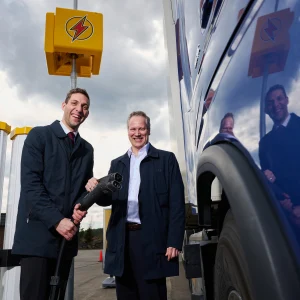
It is now possible to operate electric heavy-duty transport between the largest cities in Southern Norway. What just a few years ago was limited to pilot projects and a handful of early adopters is now becoming part of everyday transport operations.
Along Norway’s main highways, a gradual shift is taking place. Trucks still stop for breaks as before, but instead of refuelling, more and more are now connecting to chargers.
This is not primarily about individual projects or actors, but about an entire system beginning to function.
Minister of Climate and Environment Andreas Bjelland Eriksen has pointed to transport as one of the most important sectors for reducing emissions:
– We have a major task ahead of us. Around 30 percent of Norway’s emissions come from transport, and we are not going to stop moving goods. We need to do it with lower emissions.
He describes a shift that is not primarily about technology, but about making an entire system work. It must work for the drivers on the road every day, for the companies delivering goods, and for the customers who depend on logistics functioning as expected.
A network of charging points for heavy transport is developing in Norway
A network beginning to come together
Just a few years ago, this was exactly what was missing. Electric trucks worked well for local and regional transport, but as soon as longer distances were involved, uncertainty became a barrier.
That situation is now changing.
Minister of Transport Jon-Ivar Nygård points out that predictable access to charging has been crucial:
– The biggest barrier has been the lack of predictable charging along transport corridors. We are now starting to see a network that makes it possible to operate electric trucks on longer routes as well.
The build-out has been rapid. In just a few years, Norway has established a network of charging stations for heavy-duty vehicles, with several hundred charging points across the country. What previously required careful planning and a degree of risk can now, to a greater extent, be handled as a standard transport operation.
At the same time, a network of charging stations has emerged along the main transport corridors in Southern Norway, located where the actual flow of goods takes place. This makes it possible to plan longer transport routes with electric trucks in a very different way than before.
This is also the key point from Enova, which has been a central driver of the development.
– We have gone from almost nothing to a basic network in a short period of time. There is still work to be done, but we have come far enough for the market to start functioning, says Carl-Erik Kullmann of Enova.
The numbers support this development. Around 3,000 electric trucks are already in operation in Norway, and at least as many are on their way into the market. The trend points towards a market share of more than 30 percent within a relatively short period.
Building where the need actually is
For St1, development takes place in close collaboration between customers and the sales organisation, which works directly with transport companies on a daily basis. This is where needs are identified, and where decisions are made about where it makes sense to expand capacity.
– The build-out is therefore not about building as much as possible, but about building where it makes sense, says St1’s Head of Sales and Retail, Daniel Wandebäck.
– Infrastructure needs to be developed where transport actually takes place. For our customers, it is crucial that charging is available along the routes they already operate, not as isolated points outside the main corridors.
This involves close cooperation with transport customers, with expansion taking place in step with how needs evolve in the market. Much of the innovation lies not only in the technology itself, but in how the system works in practice.
The ambition is for solutions to work without friction in everyday operations. Drivers should be able to stop, connect, take their break and continue their journey without having to make adjustments that affect efficiency.
Much of this comes down to practical details: high charging capacity, the ability to charge without disconnecting the trailer, and facilities adapted to a working day on the road. These are aspects that receive little public attention, but in practice determine whether the solutions are used or not.
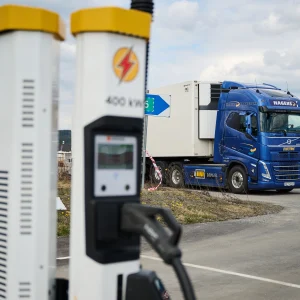
Heavy Transport charging point with an electric trailer in the background
A joint effort driving development forward
The expansion is the result of an interaction between public support mechanisms and private investments. Authorities contribute with funding schemes and prioritisation, while companies such as St1 develop and operate the stations.
– To get this started, someone has to take the lead and make the initial investments. The goal is for this to eventually become a well-functioning market, says Nygård.
The experience from passenger cars shows how this development can unfold: first infrastructure, then demand, and finally a market that can stand on its own.
Still at an early stage
At the same time, the development is still in an early phase. Coverage is not complete, capacity needs to be expanded further, and more vehicles are required.
– The next bottleneck is not only infrastructure, but the number of vehicles, says Wandebäck.
He also points out that electrification alone will not be sufficient.
– We need to use multiple energy carriers. For us, electricity and biogas are the two most important solutions in this transition, together with biofuels and mandated blends to fossil fuels.
In Norway, St1 has established charging points for heavy-duty transport along key transport corridors, from Southern Norway via Eastern Norway and further north, with new locations being developed in line with demand from transport customers.