
Research continues in St1’s geothermal wells in Otaniemi, Espoo Finland
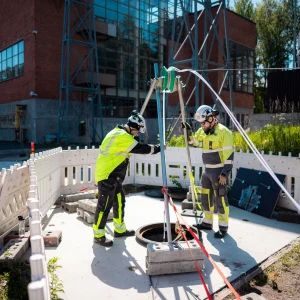
Two geothermal wells reaching depths of more than six kilometres were drilled between 2016 and 2020 as part of St1’s geothermal heat plant pilot project in Otaniemi, Espoo, Finland. At these depths, the bedrock temperature rises to approximately 120°C. Although the project aimed at energy production, it did not proceed to commercial operation due to insufficient flow rates. The wells have since taken on a new role as a research platform: they were first used for scientific research in 2024, and in May 2026, the research entered a new phase focusing on a more detailed analysis of water and gases in the deep bedrock. The research is carried out by a research group led by the University of Helsinki.
Larger and more representative samples from deep bedrock
The aim of the spring 2026 research phase is to obtain substantial samples of water and dissolved gases from the Otaniemi OTN-2 deep well at a depth of approximately three kilometers. Sampling will be carried out by pumping, enabling significantly larger sample volumes than previously and reducing the risk of contamination. This is believed to be the deepest pumping operation ever carried out using Finnish equipment.
The follow-up study builds on results from 2024, when it was demonstrated that microbial life exists in the bedrock at depths of up to five kilometres and temperatures of around 100°C. The water was found to be highly saline and gas-rich, containing hydrogen, helium and nitrogen, among others. However, the samples collected at that time were very small - approximately 600 millilitres - limiting the representativeness of the analyses.
Due to technical constraints, the current pump sampling is limited to a depth of three kilometres. This limitation is not expected to affect the representativeness of the study, as the 2024 results indicate that the composition of the well water is homogeneous throughout its length. The water present in the well originates from bedrock depths of 4.9–6.2 kilometres and rose into the well as a result of increased pressure during the 2020 stimulation phase.
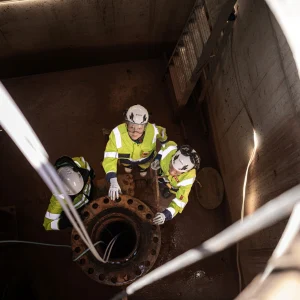
Researchers from the University of Helsinki, VTT Technical Research Centre of Finland, and the Geological Survey of Finland (GTK) next to the geothermal well borehole.
A unique international research environment for deep bedrock studies
The Otaniemi geothermal wells enable fundamental research that provides new insights into bedrock conditions, the prerequisites for life in the deep biosphere, and the future potential of geothermal energy. With depths exceeding six kilometres, the wells form a rare research environment even on an international scale and offer long-term opportunities for multidisciplinary scientific work.
The spring 2026 research is carried out by the University of Helsinki, VTT Technical Research Centre of Finland, and the Geological Survey of Finland (GTK), with safety supervision provided by Elcoline.
“It is remarkable that St1’s deep wells have been kept open and can now be used to study ancient waters in the bedrock and the deep biosphere. Never before in Finland has it been possible to study large, representative samples obtained from such depths”, says Professor Ilmo Kukkonen who coordinates the project at the Department of Geosciences and Geography, University of Helsinki.
Following the fieldwork, the samples will be analysed, which is expected to yield significant new knowledge about deep bedrock conditions:
“Once the samples have been analyzed, we will gain significantly more insight into the saline waters, gases, and microbial life in the bedrock, as well as their interrelationships”, Kukkonen says and continues:
“The potential for utilizing the Otaniemi deep wells for broader international research has also been explored. The aim is to develop a project that advances the use of deep geothermal energy and fundamental bedrock research – and the Otaniemi deep wells, together with the data collected from them, provide an excellent foundation for this.”
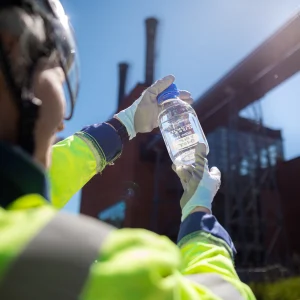
Sample from the Otaniemi geothermal well.
Otaniemi project as a forerunner in geothermal energy development
The expertise gained in Otaniemi has already been applied in the development of conventional geothermal wells and ground-source heat solutions, enabling increasingly competitive and low-emission heating for larger properties such as housing companies and shopping centers.
“The Otaniemi geothermal pilot was a significant investment for St1 and helped build entirely new expertise – it’s great that the unique environment created through it can also be utilized for research. We hope that the data gathered from the wells will also contribute to the development of new innovations”, says Jussi Rytkönen, Geologist at St1.
Read more about the previous research phase (10/2024): St1 geothermal wells in Otaniemi now in research use | St1